
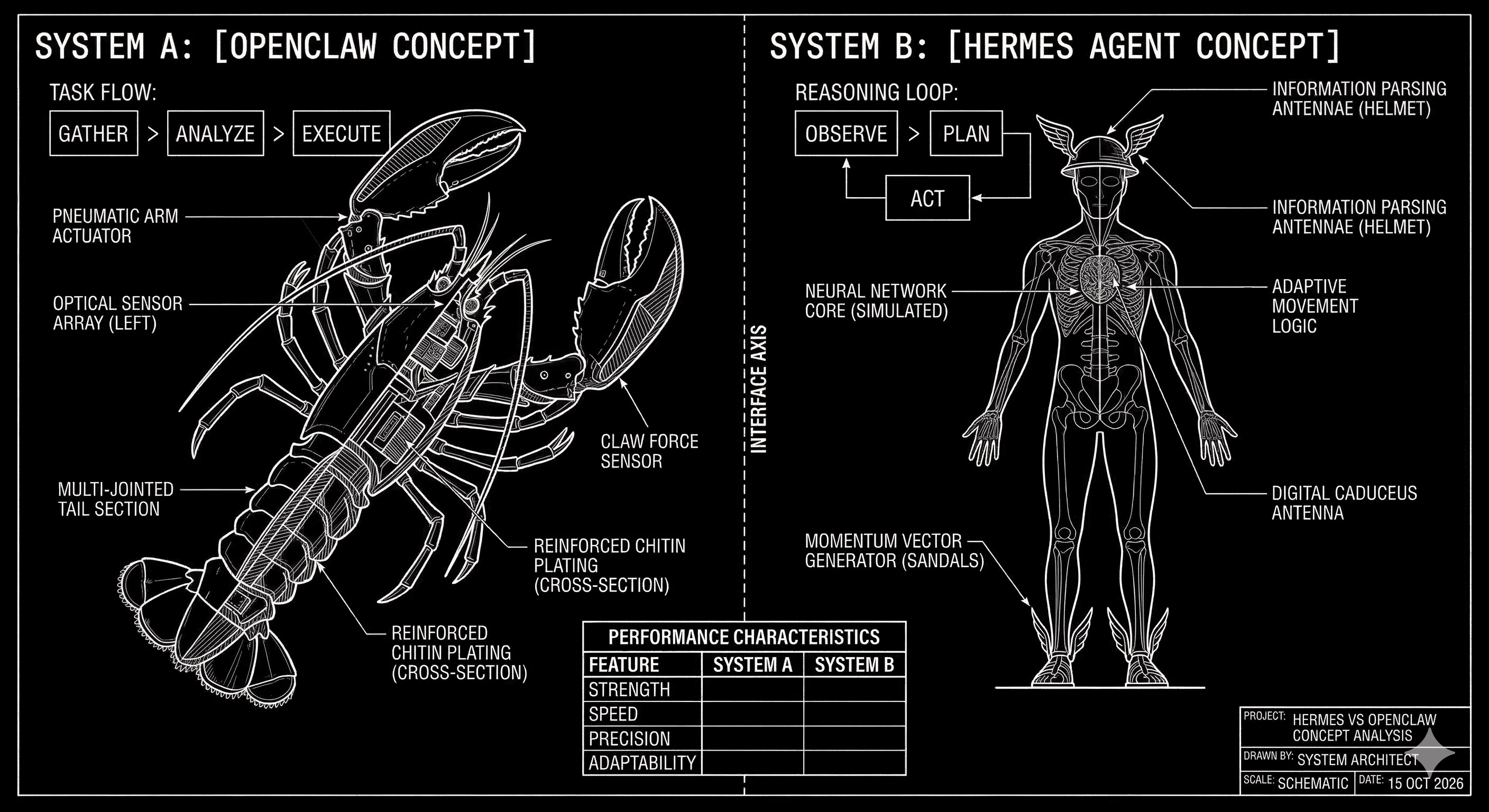
If you are comparing OpenClaw and Hermes Agent, you are already past the "should we use AI at all" stage. The real question is what kind of AI worker you want to own. OpenClaw is strongest when you need one assistant to operate across multiple business channels with clear routing, shared workspaces, and a control surface your team can manage. Hermes Agent is strongest when you want a persistent personal agent that lives on your own machine, remembers your projects, builds reusable skills from experience, and can double as a research or training-data engine. Both are open source and MIT-licensed. They are not interchangeable.
This comparison is grounded in the current official docs and product pages for OpenClaw and Hermes Agent. The goal is not to crown a universal winner. It is to help you avoid buying a week of setup pain for a job that should take an afternoon.
The Short Version
Choose OpenClaw if your business needs an owned assistant that can live across Telegram, WhatsApp, Discord, iMessage, browser chat, or other team-facing channels from one central message hub. Choose Hermes Agent if you want a personal agent that keeps long-term memory, creates its own reusable skills, and can grow into a heavier research workflow over time.
Put differently: OpenClaw is the stronger operations and channel product. Hermes Agent is the stronger personal-agent and research-lab product.
| Framework | Best Fit | What You Get Fastest | What Slows You Down | Founder Verdict |
|---|---|---|---|---|
| OpenClaw | Customer support, internal ops, and one assistant across several channels | A central message hub, browser dashboard, shared sessions, and business-facing skills | More routing decisions, more channel setup, and more care needed around third-party skills | Best when the assistant is a team asset, not just a solo productivity toy |
| Hermes Agent | Founder workflow automation, persistent memory, and research-heavy personal use | Fast install, 40+ built-in skills, long-term memory, and self-created reusable skills | Less naturally shaped for shared business routing and more biased toward a personal operator model | Best when one high-leverage operator wants an agent that keeps learning from daily work |
Key Takeaway
OpenClaw is the better bet for a business assistant that has to show up reliably across channels and teams. Hermes Agent is the better bet for a persistent personal agent that compounds value through memory and skill creation.
Single operator
Memory + Skills
Team
Multi-channel
Single + Channels
Team + Memory
Single Operator ←→ Team
Match your use case to the right product. Most founders land in one of the four quadrants.
Why Founders Are Comparing These Two Right Now
Because managed AI products still look cheap in a demo and expensive in month three. A founder can start a commercial support bot quickly, then discover per-resolution fees, seat limits, or channel restrictions that make the economics ugly once real usage arrives. Open-source agents flip that trade. You own the runtime, the memory, and the model choice.
OpenClaw Is Better When The Job Lives Across Channels
OpenClaw's core idea is the Gateway, which is best understood as a central message hub. One process handles sessions, routing, and channel connections so the same assistant can respond across multiple chat surfaces without becoming five separate bots. The official docs emphasize WhatsApp, Telegram, Discord, and iMessage from one Gateway, plus plugin-based extensions and a browser control UI.
That matters more than it sounds. Most founders do not need a smarter chatbot first. They need fewer operational fragments. If your support lead uses Telegram, your ops team uses Discord, and you still want a browser view for oversight, OpenClaw is built for that mess.
What OpenClaw Does Better Than Hermes Agent
- Channel sprawl: Better fit if your assistant has to live in several places at once and keep the business logic centralized.
- Shared operations: Stronger for team-owned assistants because the product is organized around routing, workspaces, and oversight.
- Skill distribution: OpenClaw's skill system is file-based and visible, with clear precedence between bundled, local, and workspace skills.
- Remote deployment shape: The docs explicitly support keeping the agent on a dedicated machine and connecting to it remotely, which is useful once the assistant becomes business infrastructure.
The tradeoff is that OpenClaw asks you to think like an operator sooner. Channels, bindings, and skill sources are powerful, but they are also decisions. If you want the background on why this architecture matters, the fastest companion read is our OpenClaw architecture guide.
Hermes Agent Is Better When One Person Wants A Persistent Digital Operator
Hermes Agent, from Nous Research, is framed very differently in its official materials. The product promise is not "one business assistant everywhere" so much as "an agent that grows with you." The landing page emphasizes persistent memory, automated skill creation, zero telemetry, 40+ built-in skills, and support for Telegram, Discord, Slack, WhatsApp, and local chat. It also highlights a one-line installer and an interactive setup path.
For a founder, that changes the mental model. Hermes is not trying to be your support control plane first. It is trying to become your durable operator. If you use the same agent for research, writing, recurring checklists, and personal workflows, Hermes has a compelling compounding story because it stores memory locally and turns useful problem-solving patterns into reusable skills.
What Hermes Agent Does Better Than OpenClaw
- Personal memory loop: Hermes is more opinionated about becoming better over time for one operator, not just serving messages reliably.
- Self-created skills: The product explicitly leans into writing reusable skill documents after solving hard tasks, which is a strong fit for recurring founder work.
- Research and training workflows: Hermes also positions itself for batch processing, trajectory export, and reinforcement-learning style workflows, which makes it attractive to teams closer to model experimentation.
- Fast personal setup: If your goal is to get one capable personal agent running on your own machine quickly, Hermes has the more direct story.
The tradeoff is that Hermes feels more personal by design. That is a feature if you want an AI chief of staff. It is a limitation if you want a clean multi-channel business assistant that a broader team can supervise and reuse.
Cost Matters More Than Feature Count
Both frameworks are free to download, so the real cost is your model spend plus your time. Founders routinely underprice that second line item. If your time is worth $100 per hour loaded, a tool that burns six avoidable setup hours already cost you $600 before it solved a single customer problem.
Here is a practical way to think about it. Model a first-year deployment for one active assistant with moderate daily use, one paid model provider, and light maintenance. These are scenario estimates, not vendor price cards, but they are useful because they force a business conversation instead of a fanboy conversation.
First-year total cost including imputed founder time at $100/hr.
| Option | Modeled Cash Cost In Year One | Modeled Owner Time | Break-Even At $100/Hour | What You Are Paying For |
|---|---|---|---|---|
| OpenClaw | $900 to $2,200 | 8 to 14 hours across setup, routing, and maintenance | 17 to 36 hours saved per year | Channel coverage, shared operations, and lower vendor lock-in |
| Hermes Agent | $800 to $2,000 | 6 to 12 hours across setup, memory tuning, and maintenance | 14 to 32 hours saved per year | Persistent personal leverage and reusable skills over time |
| Managed support platform benchmark | $6,000 to $24,000+ | 2 to 6 hours, because the vendor hides more setup | 60 to 240 hours saved per year | Convenience, support, and platform markup |
The important point is not that OpenClaw beats Hermes by a fixed number or the other way around. The point is that both can pay back quickly if they remove a recurring bottleneck. Twenty minutes saved per weekday is roughly 87 hours per year. That dwarfs the software cost and makes framework fit the real variable.
Where OpenClaw Wins In A Real Business
OpenClaw wins when your assistant needs to be a durable business system. Think customer support, inbound lead qualification, internal ops requests, or an always-on assistant shared across a few people. The product is closer to infrastructure, in the good sense. It is designed around one source of truth for sessions and channel traffic. That makes it easier to build one assistant with consistent behavior instead of several disconnected ones.
It also wins if you care about skill organization. OpenClaw's docs spell out where bundled, local, and workspace skills live, and how precedence works. For a small team, that reduces ambiguity. You know what the assistant loaded, where it came from, and which version should win.
Where Hermes Agent Wins In A Real Business
Hermes wins when a single founder, operator, or researcher is the center of gravity. If your biggest pain is not channel coverage but repeated personal work, Hermes has a cleaner emotional pitch and a cleaner setup path. It is easy to imagine a founder using Hermes daily for market scans, planning memos, recurring SOPs, and project context that should not reset every morning.
Hermes also has a sharper story for teams doing model experimentation or data generation.
The Hidden Risk In Both Choices
Ownership shifts power to you, but it also shifts responsibility to you. With OpenClaw, the public skill ecosystem is powerful, and that means you need to review what you install with the same seriousness you would apply to any executable software. With Hermes, the risk is different: you can end up with an impressive personal agent that never becomes team infrastructure because it was optimized around one operator from day one.
Start with the workflow, not the brand. If you need a better business surface for AI, pick the product built around channels and operational control. If you need compounding leverage for one high-output operator, pick the product built around memory and skill growth. For the broader ownership case, our open-source AI assistant primer and hosting cost breakdown go deeper on the economics.
The Decision Rule I Would Use
- Choose OpenClaw if you want one assistant across several channels, shared operational ownership, and a stronger business-system shape.
- Choose Hermes Agent if you want one persistent personal agent that gets better as it learns your work and turns hard-won patterns into reusable skills.
- Choose neither yet if you still do not know which weekly bottleneck you want the agent to remove. The framework is not the first decision. The job is.
Your Next Step
Give both products the same seven-day test. Pick one recurring task that already costs real time, such as inbound lead triage, support replies, daily market monitoring, or weekly planning prep. Measure three numbers only: minutes saved, quality of the first usable output, and amount of cleanup needed before a human could trust it.
If the task is multi-channel and team-facing, start with the OpenClaw getting started docs. If the task is founder-facing and memory-heavy, install Hermes on a spare machine and see whether it saves you at least 30 minutes this week. That is enough signal to make a rational call.
Related posts
Deploy a Hermes Agent for free
Start a 3-day free trial and launch a Hermes Agent on getclaw in minutes.