
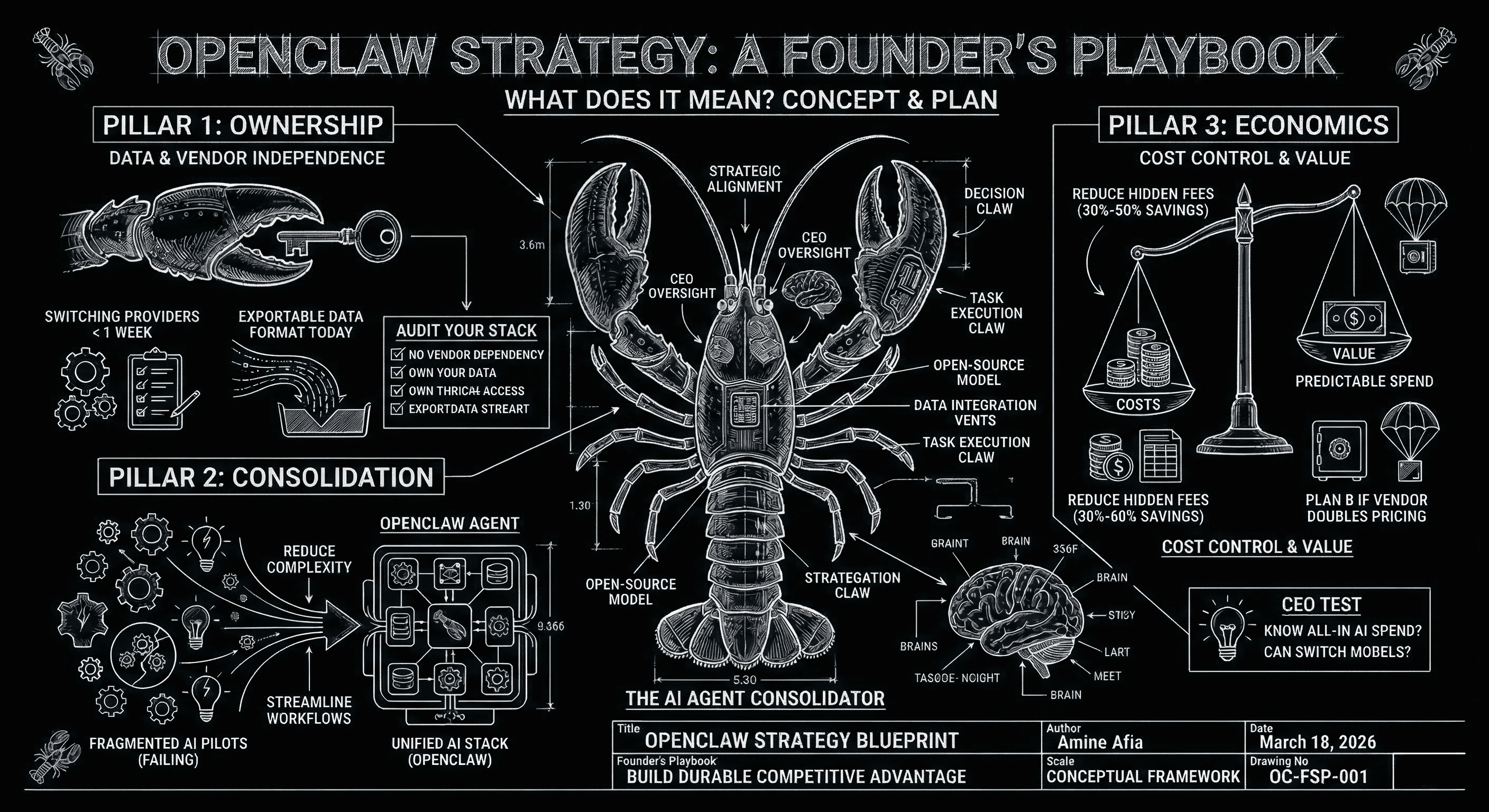
Eighty-nine percent of small businesses now use AI in some part of their operations. At the same time, roughly 80% of AI projects fail to deliver measurable value. The gap between those two numbers is not a technology problem. It is a strategy problem. Having an "OpenClaw strategy" does not mean installing OpenClaw and hoping for the best. It means making three deliberate decisions about ownership, consolidation, and cost control that determine whether your AI investment compounds or collapses.
This post gives you a framework you can apply in a single meeting. By the end, you will know how to audit your current AI stack, quantify the risk you are carrying, and decide whether an open-source approach is worth the switch.
The $315,000 Problem No One Talks About
The average cost to migrate off a proprietary AI vendor is $315,000. That number comes from the 2025 DevOps Migration Index, a CloudBees survey of over 300 enterprise IT leaders, and it accounts for engineering hours, data re-integration, and lost productivity during the switchover. The same study found that 57% of enterprises spent over $1 million on migrations in a single year, with projects running an average of 18% over budget.
Meanwhile, 49% of developers now use five or more AI tools in their daily workflow. GitLab's DevSecOps survey found that those fragmented toolchains cost teams an average of 7 hours per week in context-switching, duplicate configuration, and data reconciliation. Seventy-six percent of teams using disconnected AI tools reported negative outcomes: missed deadlines, inconsistent outputs, or security blind spots caused by tools that do not talk to each other.
These are not technology problems. You cannot fix them by choosing a better model or adding another SaaS subscription. They are strategy problems, and they require strategic answers.
What an AI Strategy Actually Is (and Is Not)
An AI strategy is not a list of tools your team uses. It is not a budget line item for API credits. It is three decisions:
- Who owns the data? Your company, or a vendor who can change terms, raise prices, or shut down?
- Who controls the model? Can you switch providers in a week, or are you locked into one vendor's ecosystem?
- Who pays the margin? Are you paying for the AI, or paying for the AI plus a 40% to 70% markup for someone else's platform?
These three decisions map to three pillars: Ownership, Consolidation, and Economics. Get all three right, and your AI investment compounds over time. Miss even one, and you are building on sand.
Key Takeaway
An AI strategy is not a tool list. It is three decisions: who owns the data, who controls the model, and who pays the margin. Everything else follows from those answers.
- Your data
- Model portability
- No vendor lock-in
- One runtime
- Shared memory
- 3,200+ skills
- 86% token savings
- No seat fees
- $20/mo managed
The three pillars of an OpenClaw strategy. Each one compounds the others.
Pillar 1: Ownership Means You Keep the Keys
IBM surveyed 2,400 IT decision-makers in 2025 and found that 51% of organizations using open-source AI reported positive ROI, compared to 41% for those using proprietary alternatives. The 10-point gap is not about model quality. It is about control. When you own the infrastructure, you own the feedback loops. You can fine-tune, customize, and iterate without waiting for a vendor's product roadmap to catch up with your needs.
Ownership means three things in practice. First, data ownership: your customer conversations, agent memory, and workflow outputs stay on your infrastructure. No vendor can train on your data, change their privacy policy, or hold your data hostage during a contract renegotiation. Second, model portability: you can swap from GPT-4.1 to Claude Sonnet to Gemini Flash without rewriting your agent's skills, memory, or integrations. OpenClaw's provider-agnostic gateway makes this a configuration change, not an engineering project. Third, prompt portability: your skills, workflows, and agent instructions belong to you. They live in plain-text files in your repository, not locked inside a vendor's proprietary format. For a deeper look at how this architecture works, see our architecture overview.
The cost of ignoring ownership is not theoretical. In 2025, Builder.ai, an AI company valued near $1 billion, collapsed into insolvency. Customers who had built their businesses on Builder.ai's proprietary platform were left stranded with no way to export their work. That is the extreme case, but the everyday version is just as damaging: a vendor raises prices 40%, changes their API, or deprecates a feature you depend on, and you have no exit strategy.
Pillar 2: Consolidation Kills the 7-Hour Tax
The 7-hour-per-week productivity loss from fragmented AI tools is not just about context-switching. It is about data fragmentation. When your scheduling assistant cannot read your CRM, and your email drafter cannot access your meeting notes, every workflow requires a human to manually bridge the gaps. You become the integration layer.
Consolidation means running one agent runtime that handles all your AI workflows through a shared context. OpenClaw achieves this with a single gateway that routes to any model provider, a shared memory system that persists across conversations and channels, and a skill ecosystem of over 3,200 community-built capabilities on ClawHub. Instead of five separate AI subscriptions that each see a slice of your business, you have one agent that sees the whole picture.
Here is what the cost difference looks like in practice.
| Factor | Disconnected stack (5 tools) | Consolidated open-source | Commercial all-in-one |
|---|---|---|---|
| Monthly software cost | $150 to $500 | $10 to $30 (API fees only) | $200 to $600 |
| Weekly time lost to integration | 7 hours | Under 1 hour | 2 to 3 hours |
| Data shared across workflows | Manual copy-paste | Shared memory, automatic | Within vendor ecosystem only |
| Vendor lock-in risk | 5 separate dependencies | None (you own the stack) | Single point of failure |
| Annual cost (solo founder) | $1,800 to $6,000 | $120 to $360 | $2,400 to $7,200 |
The consolidated open-source approach is not just cheaper. It eliminates an entire category of work: the manual data bridging that eats 7 hours every week. For a more detailed breakdown of hosting costs, see our cost analysis.
Key Takeaway
Consolidation is not about using fewer tools. It is about eliminating the human labor of connecting them. One runtime with shared memory replaces five subscriptions and the 7 hours per week you spend being the glue between them.
Pillar 3: The Economics of Open vs. Closed
A Linux Foundation study of open-source AI economics found that open-weight models cost an average of $0.23 per million tokens, compared to $1.86 per million tokens for closed-model APIs. That is an 86% cost reduction at the token level.
Translate that to business terms. A company running 2,000 AI-assisted conversations per month (customer support, internal Q&A, sales outreach) spends $10,000 to $25,000 per year more on closed-model APIs than it would with an open-source stack delivering equivalent quality. Over three years, that gap funds a full engineering hire.
The economics get more interesting at scale. The AI agent market is projected to reach $9 to $11 billion in 2026 and $183 billion by 2033, according to Grand View Research. As the market grows, closed platforms will face pressure to raise prices to satisfy investors. Open-source costs trend in the opposite direction: model efficiency improves, community contributions reduce per-user costs, and infrastructure commoditizes. Your margins widen every year instead of narrowing.
First-year total cost including imputed founder time at $100/hr.
For a hands-on calculator that maps these numbers to your specific use case, try our ROI calculator.
The CEO Test
McKinsey's State of AI research found that companies classified as AI high performers are three times more likely to have strong senior leadership ownership of AI initiatives than everyone else. The pattern is consistent: when the CEO treats AI as a strategic priority rather than delegating it to a department, the organization makes faster decisions, aligns resources more effectively, and avoids the drift that turns a promising pilot into a stalled experiment.
Here are four questions every founder or CEO should be able to answer about their AI stack. If you cannot answer all four, you do not have an AI strategy yet.
- Can I switch model providers in under a week? If the answer is no, you have a vendor dependency, not a strategy.
- What is my plan B if my primary AI vendor doubles pricing? If you do not have one, your margins are someone else's decision.
- Do I know my all-in AI spend, including hidden fees? Seat licenses, overage charges, premium support tiers, and integration costs add 30% to 60% on top of the sticker price.
- Is my AI data exportable in a standard format today? Not "in theory" or "on the enterprise plan." Today, in a format another system can use.
Key Takeaway
AI high performers are 3x more likely to have strong CEO ownership of AI strategy. The CEO test is four questions: provider portability, pricing resilience, cost transparency, and data exportability. If you can answer all four with confidence, you have a strategy. If not, you have a vendor subscription.
Your Next Step
An OpenClaw strategy is a decision framework built on three pillars. Ownership: your data, models, and prompts stay under your control. Consolidation: one runtime replaces a fragmented stack and eliminates the integration tax. Economics: open-source models and community skills cut costs by 80% or more, and the savings compound as you scale.
You have two paths forward. If you want full control, self-host OpenClaw on your own infrastructure. The open-source primer walks you through the setup. If you want the same strategic benefits without managing infrastructure, getclaw offers managed OpenClaw hosting starting at $20 per month with no seat fees and no lock-in.
The best AI strategy is one you can explain in three sentences. If you cannot, you do not have one yet.
Related posts
Deploy your AI assistant
Create an autonomous AI assistant in minutes.