
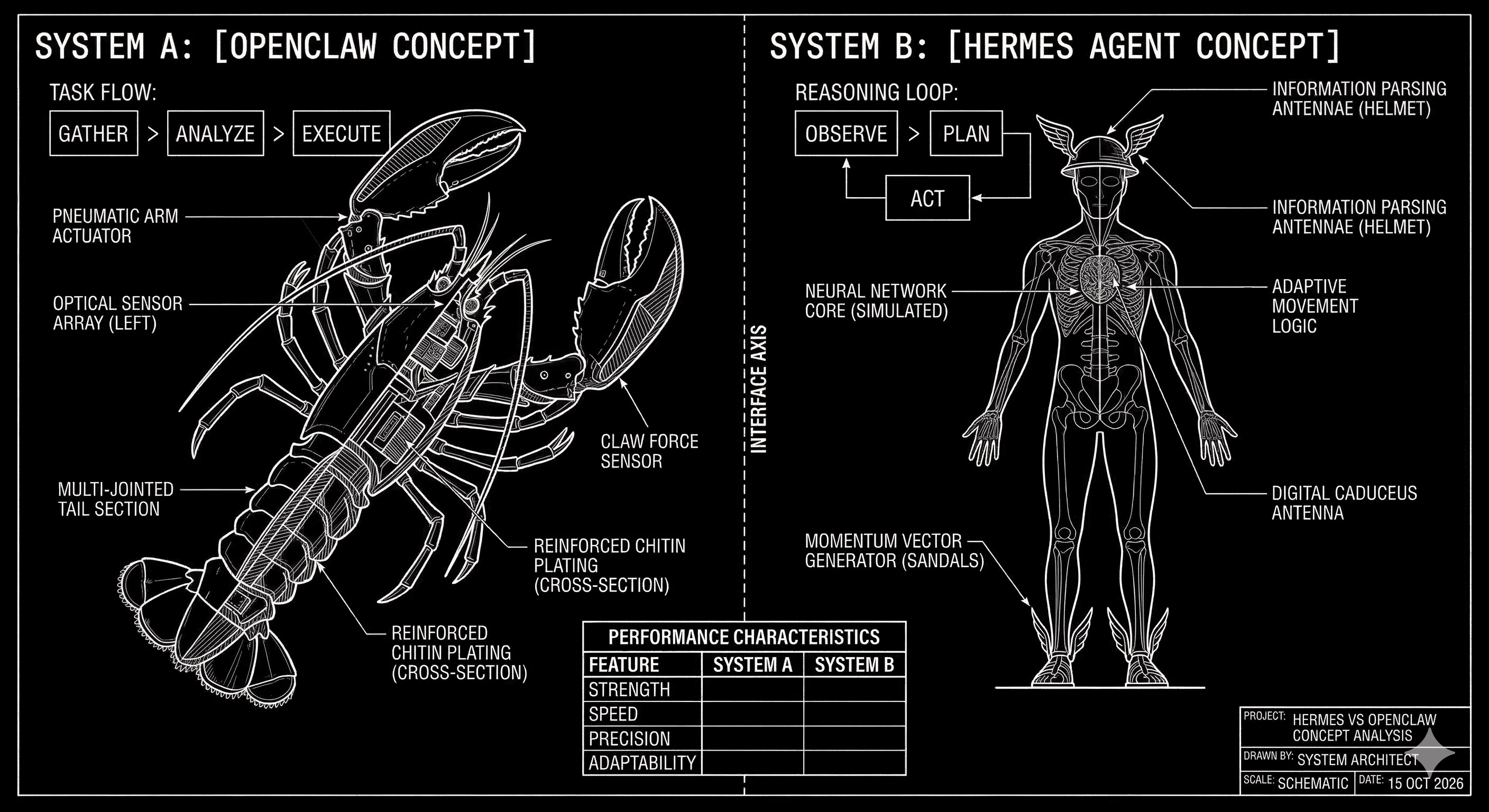
Our strategic comparison of OpenClaw and Hermes Agent covered which product to bet on and why. This post goes one level deeper. Instead of asking "which is better overall," we are asking "which feature actually saves me money, time, or headaches this quarter?" Every section below maps a specific capability to its business value, so you can score each one against your own priorities and skip the rest.
Both products are open source and MIT-licensed. Both connect to major messaging platforms. Both support multiple AI models. That is where the similarities end. The details underneath each feature are different enough that picking the wrong one can cost you weeks of rework. The tables and verdicts below are grounded in the current OpenClaw docs and Hermes Agent docs as of March 2026.
Hub-spoke: infrastructure-first
Concentric growth: agent-first
OpenClaw routes through a central Gateway; Hermes grows outward from a single Agent.
The Feature Scorecard at a Glance
Before we go feature by feature, here is the high-level picture. "Edge" means the product has a meaningful structural advantage, not that the other product cannot do it at all.
Feature edges at a glance. Each bar shows which platform has the structural advantage.
| Feature Area | OpenClaw Edge | Hermes Agent Edge | Founder Value |
|---|---|---|---|
| Multi-Channel | Central Gateway hub, one process for all channels | Signal support, conversation continuity across platforms | Fewer disconnected bots to maintain |
| Memory | Per-assistant isolation, shared team context | Multi-level memory with FTS5 search and LLM summarization | Less repeated context, faster answers |
| Skills & Tools | 52+ built-in skills, file-based precedence system | 40+ tools, auto-generated skills from problem-solving | Time saved per task the assistant can handle alone |
| Automation | Heartbeat scheduler (configurable intervals) | Natural language cron, parallel subagents | Tasks that run without you initiating them |
| Model Support | BYOK for Claude, GPT, Gemini, xAI, Groq, Mistral | 200+ models via OpenRouter, Nous Portal, custom endpoints | Model flexibility controls your per-message cost |
| Deployment | Managed option via getclaw, cloud containers | 6 backends including serverless (Modal, Daytona) | How fast you get from install to production |
| Security | Device pairing, gateway auth, access controls | Zero telemetry, container sandboxing | Confidence that your data stays yours |
| Learning | Skill distribution and workspace management | Self-improving skills, training data export (ShareGPT) | Agent improves over time without manual tuning |
Key Takeaway
OpenClaw wins on channel coverage, team operations, and managed deployment. Hermes Agent wins on model breadth, self-improving skills, and research workflows. Neither product wins every row. The right choice depends on which three or four features match your biggest bottleneck.
Multi-Channel: Who Connects Where
OpenClaw routes all messages through a single Gateway process. WhatsApp, Telegram, Discord, iMessage, Slack, and a built-in browser chat all land in the same session manager. For a founder running a small support team, that means one assistant with one memory space replying consistently across every surface. You do not need five separate bots with five separate configs.
Hermes Agent covers Telegram, Discord, Slack, WhatsApp, Signal, and the CLI. The notable addition is Signal, which matters if your team or customers prefer encrypted channels. Hermes also emphasizes conversation continuity: you can start a task on the CLI, get a notification on Telegram, and resume on Discord without losing thread context.
Founder verdict: If you need the assistant visible on five or more business channels from day one, OpenClaw's Gateway architecture is built for that job. If your team relies on Signal or you personally want seamless cross-platform handoff, Hermes has the edge.
Memory: What the Agent Remembers (and Why That Saves Time)
Every time an AI agent forgets context, someone has to re-explain the situation. At $100 per hour of founder time, a three-minute re-explanation twice a day adds up to roughly $2,500 per year in wasted effort. Memory is not a nice feature. It is a cost center when it is missing.
OpenClaw stores cross-session persistent memory per assistant. Each assistant maintains its own isolated storage, which is useful when you run separate assistants for support, sales, and internal ops. Team members interact with the same assistant and benefit from shared context without leaking data between roles.
Hermes Agent takes a more layered approach. Its multi-level memory system includes session memory (current conversation), persistent memory (facts and preferences across sessions), and skill memory (solution patterns the agent has learned). It adds full-text search (FTS5) and LLM-powered summarization, meaning the agent can retrieve relevant context from months of history without exceeding the model's context limits.
Founder verdict: OpenClaw's isolation model is better for team-facing assistants where data separation matters. Hermes's search-and-summarize memory is better for a personal operator who needs deep recall across a long history of varied work. For a deeper look at why persistent memory changes the economics of AI assistants, see our guide to adding memory to conversational AI.
Skills and Tools: What the Agent Can Actually Do
Skills are where an agent goes from chatbot to worker. The more tasks it can handle without human intervention, the more hours it saves you per week.
OpenClaw ships with 52+ built-in skills and uses a file-based system with clear precedence: bundled skills ship with the product, local skills live on your machine, and workspace skills belong to a specific project. You always know which version of a skill the assistant loaded and where it came from. That transparency matters when your assistant handles customer-facing tasks and you need to audit what it is doing.
Hermes Agent ships with 40+ tools covering web operations, file management, vision analysis, image generation, and planning. The standout feature is auto-generated skills: when Hermes solves a complex problem, it can write a reusable skill document capturing the approach. Over weeks, this builds a custom skill library tuned to your specific workflows. Hermes also supports the agentskills.io standard for community-shared skills.
Founder verdict: OpenClaw gives you more skills out of the box and stronger governance over which skills are active. Hermes gives you fewer initial tools but a compounding advantage if you use the agent daily, because its skill library grows from your actual work.
Automation: Tasks That Run Without You
A founder who checks in on the assistant every 30 minutes to kick off the next task is not saving time. Real value comes from tasks the agent handles on its own, sending a daily customer summary, flagging overdue invoices, or compiling a weekly report.
OpenClaw uses a Heartbeat system. Every 30 minutes (configurable), the Gateway wakes the agent, and the agent checks a task queue. If something needs attention, it acts. If not, it goes back to sleep. This is a clean pattern for business-facing automation: daily digests, proactive alerts, and recurring reports all fit naturally into the heartbeat cycle.
Hermes Agent offers a natural language cron scheduler. You tell the agent "every weekday at 9am, summarize my inbox and post to Slack," and it creates the schedule without config files. Hermes also supports parallel subagent processing, meaning it can delegate pieces of a complex task to specialized sub-agents that run concurrently. That is useful for batch work like processing 50 support tickets or analyzing a dozen competitor pages at once.
Founder verdict: OpenClaw's heartbeat is simpler and more predictable for business workflows with regular cadence. Hermes's natural language scheduling and parallel processing are more powerful for complex, ad-hoc automation. If your automation needs are "send me a report every morning," either works. If they are "research 20 leads in parallel and rank them," Hermes has the edge.
Model Support: Controlling Your Biggest Variable Cost
The AI model you choose determines your per-message cost. A single assistant handling 200 messages per day on a premium model (Claude Opus, GPT-4o) can run $300 to $800 per month in model fees. Switching to a cheaper model for routine queries can cut that by 60 to 80 percent. Model flexibility is a cost lever, not a technical detail.
OpenClaw supports Claude, GPT, Gemini, xAI, Groq, and Mistral through a bring-your-own-key setup, plus OpenRouter for broader access. You configure your API key once and switch models without redeploying. For most founders, that covers the top-tier models plus a few cost-effective alternatives.
Hermes Agent connects to 200+ models through OpenRouter, plus direct integrations with Nous Portal, OpenAI, Kimi, MiniMax, and custom endpoints. You can switch models with a single command. The broader model catalog is useful if you want to experiment with niche or open-weight models, or if you want to route different task types to different models (premium for customer-facing, budget for internal summaries).
Founder verdict: Both products support the models that matter most (Claude, GPT, Gemini). Hermes has the wider catalog if you want to optimize cost by routing to specialized or open-weight models. For a detailed breakdown of how model choice affects your hosting bill, see our AI hosting cost breakdown.
Deployment: From Install to Production
Every hour spent on deployment is an hour not spent on the work the assistant is supposed to handle. Setup time is a real cost even when the software is free.
OpenClaw supports cloud containers, self-hosted setups on a VPS, and a managed deployment option through getclaw. The managed path gets you from zero to a running assistant in under five minutes without touching server configuration. The self-hosted path gives you full control but requires more setup.
Hermes Agent offers six deployment backends: local machine, containerized environments, SSH to a remote server, Daytona, Singularity, and Modal. The one-line installer handles local setup on macOS, Linux, and WSL2. The serverless options (Daytona, Modal) are notable because your environment hibernates when idle, keeping costs near zero between sessions. That is attractive if your usage is bursty rather than constant.
| Deployment Factor | OpenClaw | Hermes Agent | What This Costs You |
|---|---|---|---|
| Fastest path to running | Managed deploy via getclaw (under 5 min) | One-line local install (under 10 min) | $0 to $8 for first hour of setup |
| Self-hosted options | Cloud containers, VPS | Local, container, SSH, Daytona, Singularity, Modal | $5 to $40/month for always-on hosting |
| Idle cost | Depends on hosting plan | Near zero with serverless backends | $0 to $20/month savings on quiet days |
| Ongoing maintenance | Lower with managed option | Self-managed across all backends | 1 to 4 hours/month of ops time |
Founder verdict: If you want zero ops burden, OpenClaw's managed path is the faster route. If you want maximum infrastructure flexibility or need serverless cost scaling, Hermes has more options.
Security: Protecting Your Data and Your Customers
An AI assistant with access to customer conversations, internal docs, and business data is a serious trust surface. Security is not optional.
OpenClaw uses device pairing (each new device must be explicitly approved), gateway token authentication for server-to-server calls, access controls for the admin interface, and per-assistant data isolation. The pairing model is similar to how you approve a new device on a banking app: nothing gets in without explicit authorization.
Hermes Agent leads with zero telemetry. No data leaves your machine unless you explicitly configure an external service. The agent runs in sandboxed execution environments, and container-based deployments add an extra isolation layer. For teams handling sensitive data, the "nothing phones home" guarantee removes an entire category of compliance questions.
Founder verdict: OpenClaw's security model is better for team environments where multiple people access the assistant and you need access controls. Hermes's zero-telemetry stance is better if your primary concern is data leaving your infrastructure entirely.
Learning and Self-Improvement: Does the Agent Get Better Over Time?
This is where the two products diverge most sharply.
OpenClaw focuses on skill distribution and workspace management. You curate which skills are available, share skill bundles across projects, and control the assistant's behavior through configuration. The improvement cycle is deliberate: you add skills, adjust settings, and expand capabilities when the business needs them.
Hermes Agent is designed to improve itself. When it solves a complex problem, it can write a reusable skill document and add it to its own library. Over weeks of use, it builds a personalized toolkit shaped by your actual work. Hermes also exports conversation data in ShareGPT format for model fine-tuning and integrates with reinforcement learning tools (Atropos) for training custom behaviors. If you are doing model research or want an agent that adapts without manual intervention, this is Hermes's strongest differentiator.
Founder verdict: OpenClaw gives you control over what the agent learns. Hermes gives you an agent that learns on its own. If you value predictability and auditability (customer-facing assistant, regulated industry), OpenClaw's model is safer. If you value compounding productivity for a single operator, Hermes's self-improvement loop is genuinely powerful.
The Real Dollar Comparison
Features only matter if they translate to saved time or reduced cost. Here is what a typical first-year deployment looks like for a founder running one active assistant at moderate daily volume (100 to 200 messages per day).
| Cost Category | OpenClaw (Self-Hosted) | OpenClaw (Managed) | Hermes Agent |
|---|---|---|---|
| Model API fees (year 1) | $600 to $1,800 | $600 to $1,800 | $500 to $1,600 |
| Hosting / infrastructure | $60 to $480 | Included in plan | $0 to $240 (serverless) |
| Setup time (at $100/hr) | $800 to $1,400 | $100 to $300 | $600 to $1,200 |
| Maintenance (year 1) | $400 to $800 | $100 to $200 | $400 to $800 |
| Total year 1 | $1,860 to $4,480 | $800 to $2,300 | $1,500 to $3,840 |
Hermes can be slightly cheaper on model costs because its broader model catalog makes it easier to route routine queries to budget models. OpenClaw's managed path has the lowest total cost of ownership because it eliminates most setup and maintenance time. Both are dramatically cheaper than managed support platforms, which typically run $6,000 to $24,000 per year for comparable message volumes.
Which Features Should Drive Your Decision
Do not try to score all eight feature areas equally. Most founders have two or three features that actually matter for their specific situation. Here is how to find yours.
- If your assistant is team-facing: Prioritize multi-channel, security (access controls), and skill governance. OpenClaw wins these three.
- If your assistant is founder-facing: Prioritize memory depth, self-improving skills, and model flexibility. Hermes Agent wins these three.
- If you want zero ops burden: Prioritize managed deployment and low maintenance. OpenClaw's managed path via getclaw is the most hands-off option today.
- If you are budget-constrained: Prioritize model breadth and serverless deployment. Hermes gives you more levers to minimize per-message and hosting costs.
- If you care about research or training: Hermes is the only choice with built-in data export and RL integration.
Your Next Step
Pick the two features that would save you the most time this month. Then install the product that wins those two features and give it a seven-day test on a real recurring task. Measure minutes saved per day, quality of the output, and how much cleanup you needed before trusting the result.
If multi-channel and team operations are your priority, start with the OpenClaw getting started guide. If memory, self-improvement, and personal productivity are your priority, grab Hermes Agent from GitHub and run the one-line installer. Either way, you will know within a week whether the product fits.
Related posts
Deploy a Hermes Agent for free
Start a 3-day free trial and launch a Hermes Agent on getclaw in minutes.